
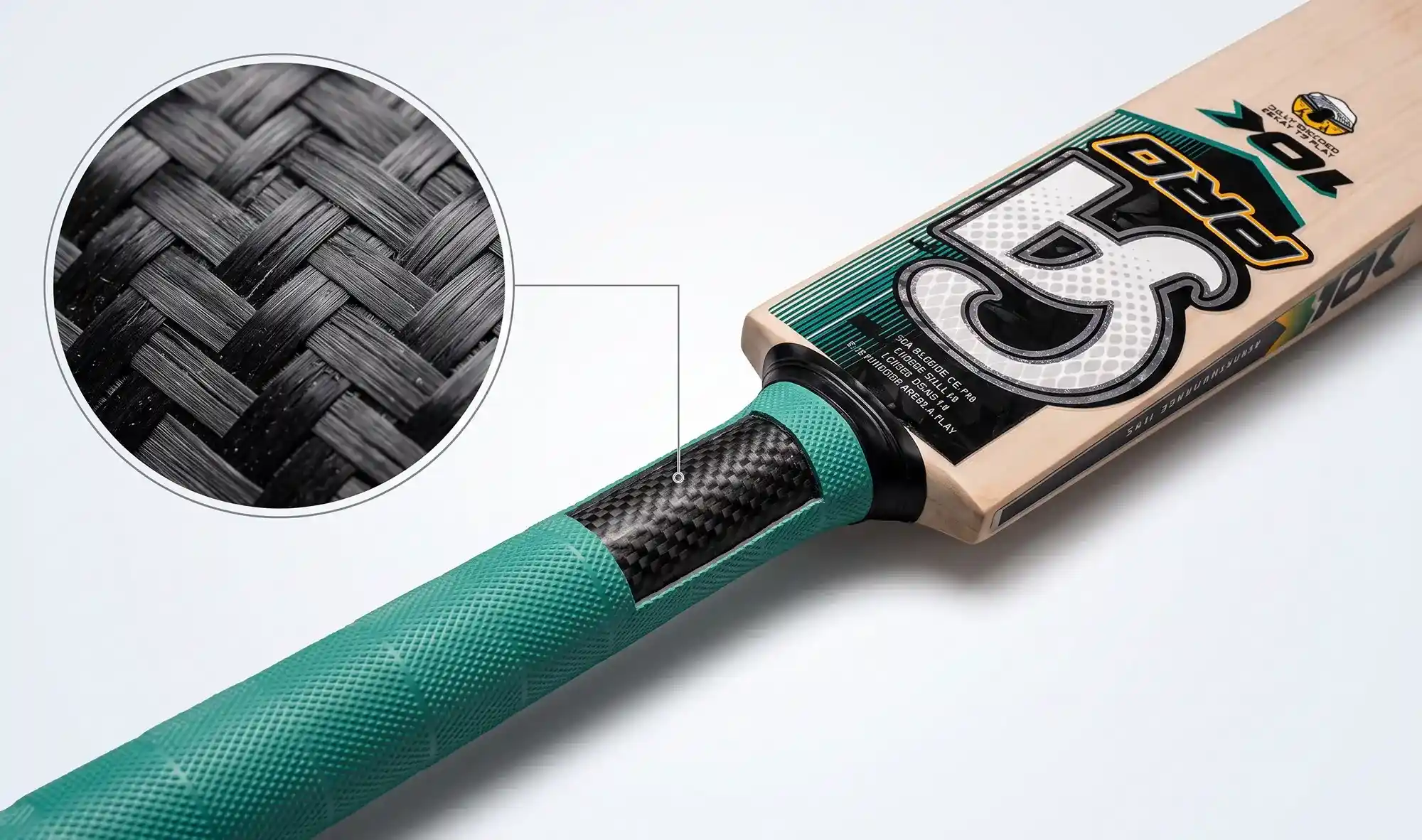
The Role of Carbon Fiber in Modern Cricket Bat Handles
Carbon fiber in cricket bat handles adds stiffness, reduces vibration, and improves power transfer without adding weight. Manufacturers insert carbon rods or weaves inside traditional cane handles to stop the bat from twisting on off-center hits. The blade of the bat must remain pure wood, but MCC Law 5 permits up to 10% non-wood material in the handle.
Key Takeaways
- Carbon fiber makes the handle stiffer and more durable without changing the bat's weight or pick-up.
- It reduces hand sting on mis-hits and helps the blade stay square at impact.
- The blade must be 100% wood, but the handle may contain up to 10% other materials under MCC Law 5.
- The rule exists because of two famous incidents: Dennis Lillee's aluminium bat (1979) and Ricky Ponting's graphite bat (2005–06).
How Are Modern Cricket Bat Handles Made?
A high-performance handle starts with multi-piece cane construction. Craftsmen slot strips of premium Singapore cane together with thin rubber layers between them. The cane gives natural flex, and the rubber absorbs shock.
Pure cane has one weakness. It can twist under the force of modern power hitting, especially when the ball strikes the toe or edge. To solve this, manufacturers insert carbon fiber rods or weave carbon layers inside the cane.
The result is a hybrid handle. The cane keeps the traditional feel that batters trust, while the carbon core stops the handle from twisting under load. In our Sialkot workshop, we test every handle design against both requirements before it reaches a match bat.
How Does Carbon Fiber Improve Cricket Bat Performance?
Better power transfer: Carbon fiber has an exceptional strength-to-weight ratio. When you face a fast delivery, a soft handle bends and wastes energy. A carbon-reinforced core holds firm and sends more energy back into the ball.
Less vibration: Edge hits and mis-hits send sharp shockwaves into your hands. The carbon layer absorbs much of this sting before it reaches your forearms, which reduces fatigue during long innings.
Longer handle life: Handles take heavy stress over a season, especially at the splice where the handle meets the blade. Carbon inserts resist the fractures that cause pure cane handles to snap.
No change to balance: Because carbon fiber weighs so little, the reinforcement does not spoil the pick-up. Bat makers can keep the light, balanced feel players want while making the handle stronger.
Cane vs Carbon-Reinforced Handles: Quick Comparison
Feature | Pure Cane Handle | Carbon-Reinforced Handle |
Flexibility | High natural whip | Controlled, responsive flex |
Twist resistance | Moderate | High — blade stays square on mis-hits |
Shock absorption | Rubber strips only | Rubber plus carbon layer |
Durability | Can snap under heavy load | Strong resistance to fractures |
Best for | Classical touch players | Power hitters and professionals |
The Science of Energy Return and Torsional Rigidity
Every time you strike a cricket ball, energy travels up the blade into the handle. Standard handles yield under intense load, losing valuable power.
Carbon fiber composite rods resist torsional torque. When the ball hits the toe or edge of the bat, the carbon core keeps the blade face square to the impact line. This torsional stiffness ensures off-center hits still clear the boundary ropes.
Furthermore, carbon fiber accelerates the handle's rebound rate. The handle flexes during the backswing and snaps back faster during ball contact, generating explosive exit velocity.
What Do the ICC and MCC Say About Bat Materials?
Cricket's laws allow carbon fiber in the handle but ban it from the blade. The MCC writes the Laws of Cricket, and the ICC enforces them in international matches. Two famous incidents shaped the rule.
1979: The Aluminium Bat That Changed the Law
In December 1979, Australian fast bowler Dennis Lillee walked out at Perth against England carrying an aluminium bat called the ComBat. He had already used it 12 days earlier against the West Indies at Brisbane. No law stopped him at the time, because the rules never imagined a metal bat.
England captain Mike Brearley protested, and Australian captain Greg Chappell made Lillee switch back to willow. The publicity pushed the MCC to change the law soon after. The new wording was simple: "The blade shall consist solely of wood." That single line still protects the balance between bat and ball today.
2005–2006: Ricky Ponting's Graphite Bat Ban
The law faced its second big test in April 2005. The ICC asked the MCC to examine Ricky Ponting's Kookaburra Kahuna, which hid a 6mm carbon graphite strip along the spine of the blade. Damien Martyn, Justin Langer, and Sanath Jayasuriya used similar bats.
The MCC ruled that the graphite strip broke the law because it strengthened the blade with a non-wood material. The ICC declared the bat illegal in February 2006 and ordered all graphite-reinforced bats out of first-class cricket by October 2006.
The Current Rule: MCC Law 5 (2017 Code)
Under today's MCC Law 5, the blade must be made solely of wood. The handle follows a different standard. For professional-grade (Type A and B) bats, at least 90% of the handle's volume must be cane, wood, or twine. The remaining 10% may be other materials, such as carbon fiber, used for purposes like reducing vibration.
This is exactly why CA Sports reinforces the handle and never the blade. You get modern composite strength while staying fully match-legal.
Why Do Professional Players Choose Composite Handles?
Professional batters face fast bowling on hard, bouncy pitches. They need equipment that responds the same way every time. A composite handle gives predictable feedback, so players can commit to aggressive shots without worrying about twist, delayed response, or hand injury. Handle stability matters in every format, from red-ball Tests to T20 tournaments.
Handcrafted in Sialkot, Trusted Worldwide
At CA Sports, our craftsmen in Sialkot, Pakistan, combine generations of woodworking skill with modern composite technology. Every bat passes strict checks for pick-up, balance, and handle response before it leaves the workshop. From hand-selected English willow blades to custom handle preparation, we craft professional cricket bats for players worldwide and ship them directly from our factory.
FAQs
Q1: Is carbon fiber legal in cricket bats?
Yes, in the handle only. MCC Law 5 allows up to 10% non-wood material in the handle of professional-grade bats. The blade must remain solely wood.
Q2: Why was carbon graphite banned from cricket bat blades?
In 2006, the ICC banned graphite-reinforced blades after the MCC ruled Ricky Ponting's Kookaburra Kahuna illegal. The 6mm graphite strip on the blade broke the wood-only rule.
Q3: Does a carbon-reinforced handle make the bat heavier?
No. Carbon fiber is extremely light for its strength. It adds stiffness and shock resistance without changing the bat's weight or pick-up.
Q4: Can a carbon fiber handle still snap?
Extreme force can break any handle, but carbon reinforcement greatly reduces the risk compared to pure cane, especially at the splice.
Q5: Which is better: a round or oval handle?
Oval handles give better bottom-hand control and blade alignment. Round handles suit players who use strong wrists and bottom-hand power. Both can carry carbon reinforcement.
Q6: How long does a cricket bat handle last?
A well-made handle typically outlasts the blade with proper care. Re-grip it each season and inspect the splice area for signs of movement or cracks.

Carbon fiber is used in some modern cricket bat handles to fine-tune the handle’s stiffness and feel. It can make the handle more stable while controlling how much it flexes when the ball strikes the bat. When engineered correctly with traditional handle materials, carbon fiber can also help manage vibration without making the bat feel unnecessarily rigid.

Recent Blog
05 Sep 2026
How to Choose the Best Cricket Helmets with Advanced Face Guard Technology

31 Aug 2026
What Protection Does a Fast Bowler Actually Need?
28 Aug 2026
Do You Actually Need a Cricket Arm Guard?
28 Aug 2026
Why Your Helmet and Neck Guard Are Crucial
22 Aug 2026
How to Replace a Cricket Bat Grip?
12 Aug 2026
The Role of Carbon Fiber in Modern Cricket Bat Handles
30 Jul 2026
How to Knock In a Cricket Bat Properly: A Step-by-Step Guide
23 Jul 2026
Cricket Bat Grains Explained: What 5, 7, and 10 Grains Really Mean